(Last updated: 02/07/2026 | PERSONAL OPINION )
Watching Silicon Valley players eating their cake with AI, many old guard analytics vendors respond with a disdain: “AI = Analytics” , “AI = extension of Analytics”, “Analytics is the godfather of AI”… PR spin aside, no matter from what angle you look at it, equating AI with analytics sounds like a bit stretch, if not wrong.
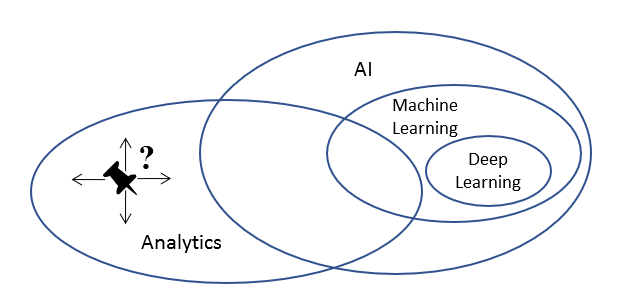
Trying to pin down the relationship between analytics and AI with a Venn diagram proves a dauting task. But two things we can all agree upon: One is the specialization relationship between deep learning, machine learning, and AI. The other is that deep learning and analytics should be considered disjoint activities.
Ladder of Analytics
As a firm’s analytic practice matures, the nature of its analytic activities advances from descriptive, to predictive and finally to prescriptive. The higher on the ladder, the more complicated but at the same time more fruitful it gets:
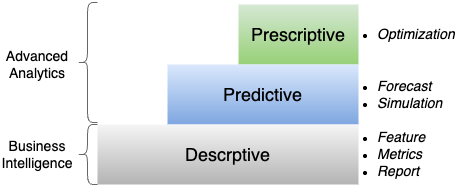
The “Analytics” we’re concerned with here is the advanced analytical approaches that some consider as symbolic AI. Think causal analysis, prediction, planning and optimization algorithms.
A Procedural View
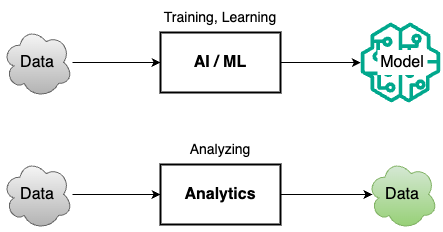
Viewing both analytics and AI/ML as data processing system, the litmus test for analytics vs AI categorization can be based on its output:
That is,
- If the output is an model, it’s AI.
- If the output is data (with more insights concentration than raw data), it’s analytics.
Of course this test is not foolproof, for example, traditional statistical procedure such as logistic regression produces a mathematical model out of the data. We may limit our test 1 to be about non-parametric model, but it still won’t be foolproof. But, you get the idea.
What exactly is a model?
Throwing another wrench into the analytics vs AI confusion is the overloaded term model. You hear:
- Forecasting model
- Optimization model
- Liner regression model
- Neural network model
- Large language model
- …
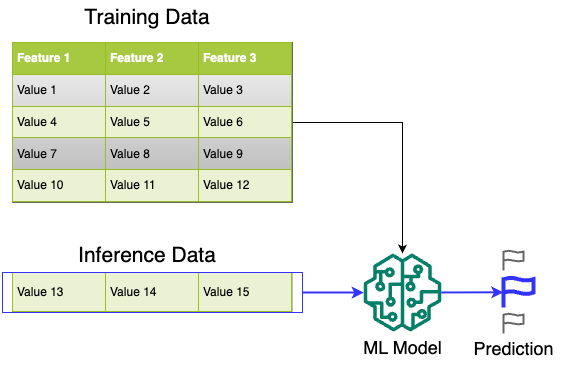
Are they all the same? The procedural view of analytics vs AI can help us understand the difference between say a ML and optimization model. To wit, an AI/ML model works like below:
- The training phase resulted in a model.
- The trained model then makes inference on new data.
But for an optimization problem:
- The problem to be optimized is specified as the model.
- The model is then fed into a solver which spits out the optimal solution.
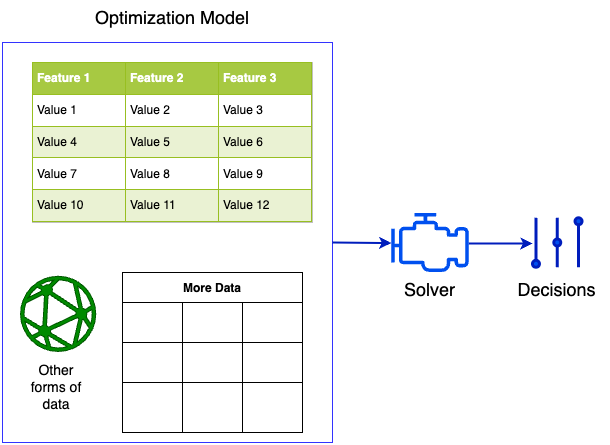
Now you see, an model in the ML realm is not the same with an model in the optimization land:
- AI/ML model captures the patterns in the data.
- Optimization model captures the formulation of the problem.
- Objective. Maximize revenue? Minimize cost?
- Constraints. Susan the financial advisor is on PTO on 02/09/2026.
- …
A Pragmatic View
Let’s forget about theory for a moment and instead focus on the challenges posed by real life problems: Complexity corresponds to number of interacting components a system has; Scale refers to number of problems to be solved; Velocity describes how fast data comes in which dictates the response time problem solver / agent has to solve the problem; Lastly but not the least, randomness in the problem domain easily messes up a perfect solution for a deterministic setting.
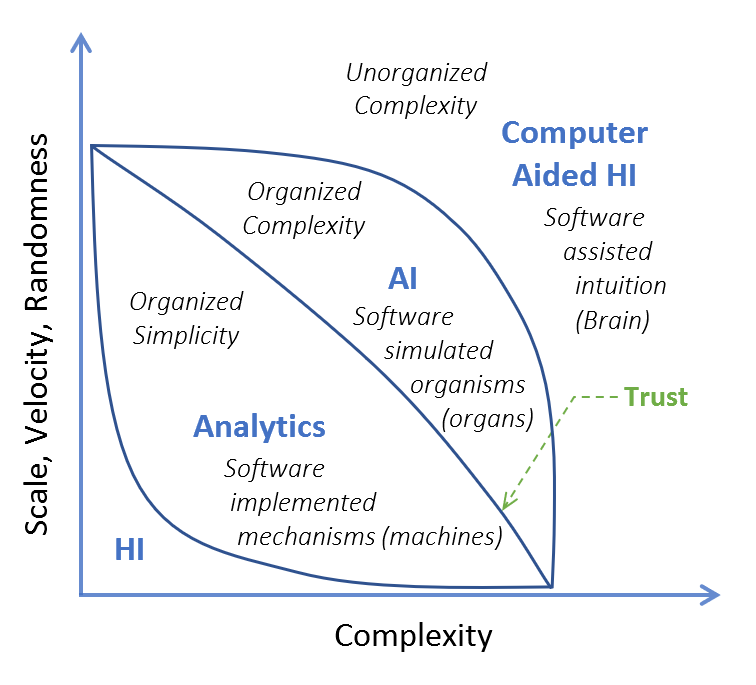
Human intelligence (HI) excels when scale is small, velocity is low, and randomness is minimal. However, thanks to the intricate network of billions of neurons in our brain, human can handle complex problem at ease. Identify cats in five pictures? No problem. Tag a million pictures in two minutes? No way.
With unlimited memory and compute which complement human’s bounded rationality, analytics tackles problems with large scale and high velocity. The rigor of probability and statistics is used to tame randomness and decision science such as rules and optimization are used to reduce complexity to manageable chunks. Analytics is software implemented machines (mechanisms) that operates in a world of organized simplicity. In this world, sum of parts equal to the whole and replacement of a part doesn’t affect the functioning of other parts in the mechanism.
AI ups the ante of analytics with self-learning capability and the relinquishment of mathematical models. Don’t bother feature engineering, feed me the raw data and I’ll figure the answer out! With the irresistible proposition comes the unexplainability of AI. The layered structure of deep neural network may look neat, but who knows what each of it’s millions of weights controls? AI is software simulated organisms which operates in the realm of organized complexity where behavior of the whole is trained without knowing exact functions of parts.
When complexity, scale, velocity and randomness of the problem increase beyond certain level than computation can handle, human intelligence is the only way out, but with the help of analytics and AI. For an example, look no further than how the quants work in the hedge fund world: analytics and AI are merely used to pick up “signals” and ultimate trading decision is made by humans.
As technology advances, boundaries among the four regions shift. For example, when we completely understand and trust how deep Convolutional Neural Network works, image recognition architecture such as AlexNet and VGGNet can be moved from AI into analytics.
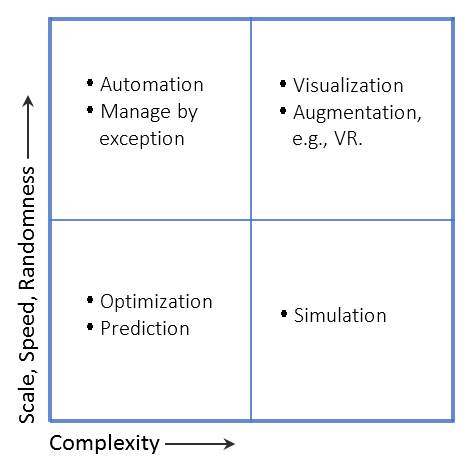
The solution approach to a given problem is dependent on where the problem lands in the complexity scale quadrant:
Use AI Where It Does the Best: Perception
A closer look at human intelligence also sheds light on the distinction between AI and analytics, in his Nobel Prize acceptance speech, Daniel Kahneman talked about “the automatic operations of perception and the deliberate operations of reasoning” which maps nicely to AI and Analytics respectively. Analytics here are codified process and contents in human cognitive system. Note that perception is not even considered as part of the cognitive system.
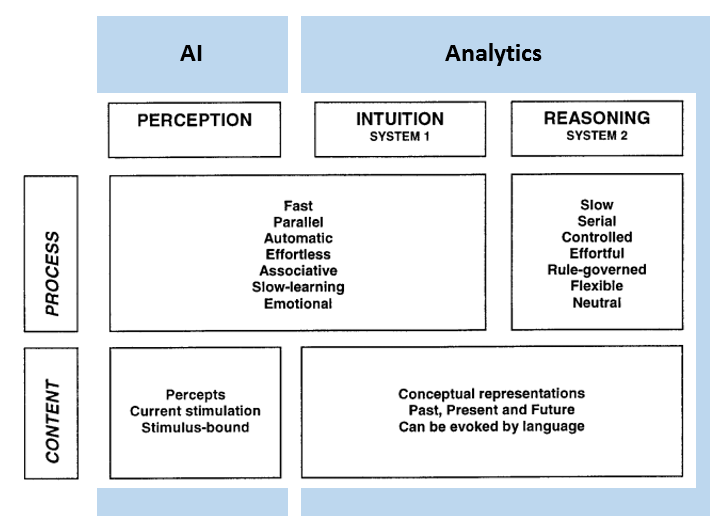
“But ChatGPT is able to solve grade school math problems now, isn’t that System II reasoning?”. Well, to answer your question, I have to invoke the word we called out in the “Pragmatic view” earlier: trust. As long as hallucinations keep happening at a noticeable rate, I won’t trust LLM with my reasoning tasks.
To Summarize
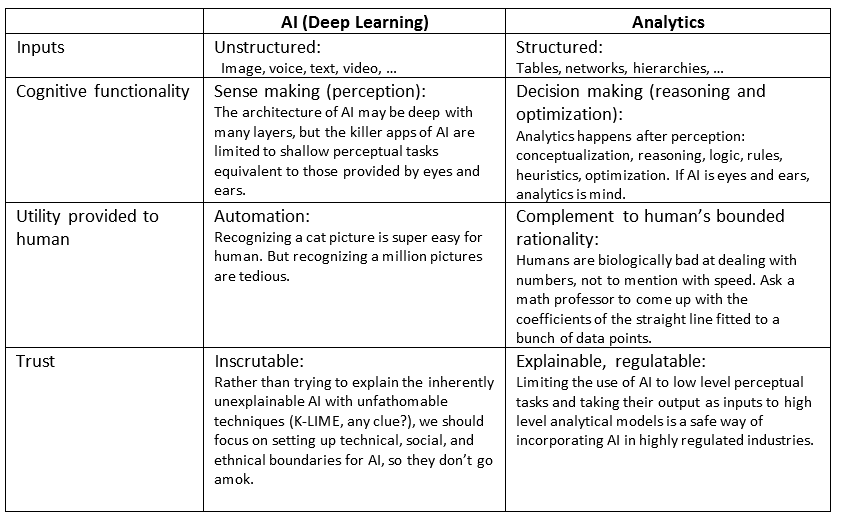
Analytics Is Still the King
It’s always the simple things that are used the most. If you do a tally of the code that are executed in production systems, I bet the work horses are simple statistics such as means, distinct count, linear and logistic regressions, and analytics workloads out weight those of AI.
The vendor who creates the most values for customers won’t be those who are the best at AI based perception such as image tagging or object detection. Rather, it’s those who offer customers the most value-adds (automation, decisions) on top of the results of AI based perception. If AI is the optic fibers construction workers stretched in your neighborhood, analytics is the last mile that delivers the gigabits service into your home.
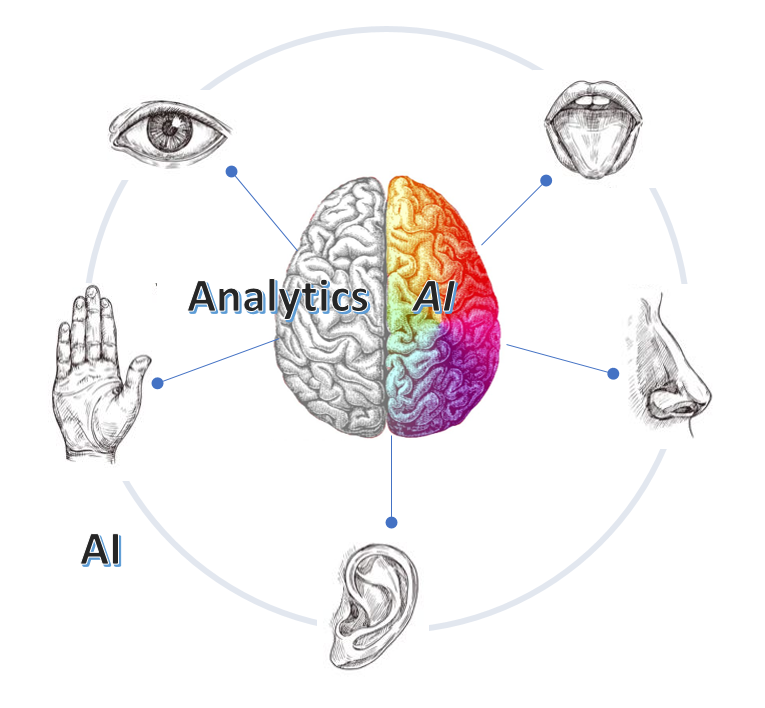
As AI matures beyond simple perception, some of the pattern finding capabilities of the right brain maybe emulated by AI. But to get to the Artificial General Intelligence (AGI), symbol-based logic capabilities of the left brain is a must.
The Right Attitude Toward AI?

We’ll take advantage of AI, but our focus is always on analytics (explainable and symbolic approaches).
References
- CMU’s Zachary Lipton blogged about the rebranding history from AI to ML then back to AI.
- Prof. Michael Jordan argued that we should tone down the hype around AI today which is really a narrow engineering field focusing on low level human imitative Machine Learning techniques. Intelligence Augmentation (IA) and Intelligent Infrastructure (II) are two of the serious challenges ahead.
- I still haven’t figured out where the word “nooscope” comes from, but their(?) view of AI as an instrument of knowledge extractivism is certainly appealing to me, both visually and mentally : )